


Have you ever sat in a meeting where half the room is excited about a “big picture” idea, while the other half is visibly stressed about the lack of a spreadsheet?
It’s a classic workplace tension. You might label it as a personality clash or a lack of buy-in. But more often than not, it’s simply a difference in thinking preference.
At Head to Head, we see this friction constantly. It’s not that your team can’t get along; it’s that they are literally speaking different cognitive languages. This is where Whole Brain Thinking shifts the dial—moving teams from frustration to high-performance flow.
The Invisible Barrier to Innovation
We often hire for “culture fit” or technical skills, but we rarely hire for Cognitive Diversity.
Cognitive diversity isn’t about what you know; it’s about how you process what you know. When a team is lopsided—for example, heavy on analytical thinking but light on relational thinking—they will inevitably hit a wall.
The research backs this up. A study by Cloverpop found that inclusive teams make better business decisions up to 87% of the time. Furthermore, research into cognitive diversity suggests it can enhance team innovation by up to 20% while reducing risk-taking by 30%.
Why? Because “whole” teams have fewer blind spots. They don’t just solve problems; they see the problem from four distinct angles before they even start solving it.
Decoding the Four Quadrants
Whole Brain Thinking, rooted in the Herrmann Brain Dominance Instrument (HBDI), maps thinking preferences into four quadrants.
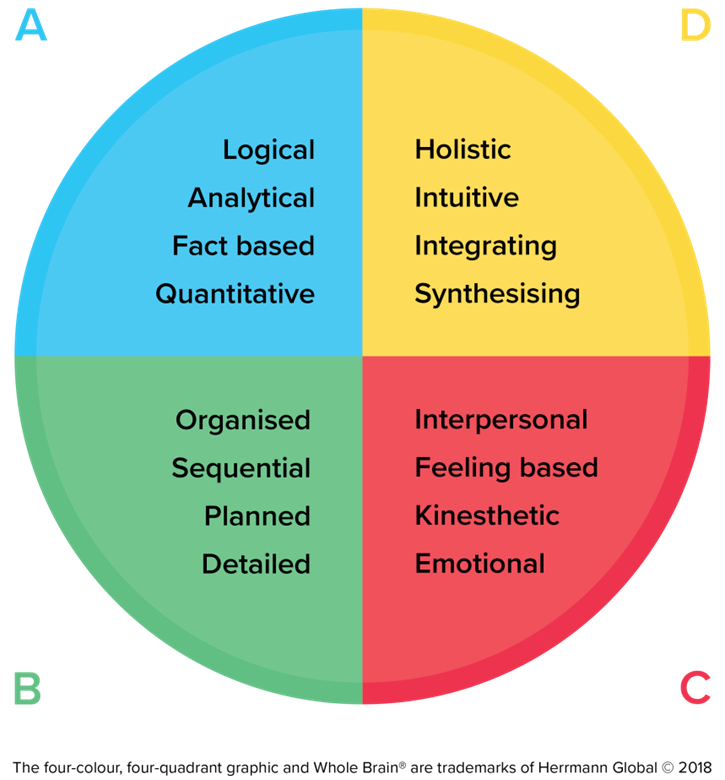
Most of us have a dominant preference for one or two of these areas, which dictates how we communicate, make decisions, and view the world.
- The Analytical (A) – “The Scientist”: Loves facts, logic, and data. They ask: “What is the bottom line?”
- The Practical (B) – “The Manager”: Loves structure, plans, and details. They ask: “How will this work?”
- The Relational (C) – “The Teacher”: Loves people, feelings, and culture. They ask: “Who will this affect?”
- The Experimental (D) – “The Visionary”: Loves big ideas, future concepts, and risks. They ask: “Why not try this?”
Why “Same-Thinking” Kills Innovation
The comfort zone of a leader is often to hire people who think like them. If you are a Visionary leader (D), you likely enjoy the energy of other big-picture thinkers.
But if your entire team resides in the “D” quadrant, you will have incredible brainstorming sessions where absolutely nothing gets executed. Conversely, a team of pure Analysts (A) might optimize a process perfectly but fail to notice that the culture is toxic (C) or that the market has shifted (D).
Research by Deloitte has highlighted that high-performing teams must have the ability to leverage these differences. When leaders understand the Whole Brain model, they stop viewing the “Practical” thinker as a roadblock to the “Visionary” idea. Instead, they see them as the safety net that ensures the idea actually launches.
How to Stop the “Unnecessary” Conflict
Much of what we call conflict is just cognitive mismatch.
- The Conflict: The Relational thinker feels the Analytical thinker is “cold” or “uncaring.”
- The Reality: The Analytical thinker is showing they care by ensuring the data is correct so the team doesn’t fail.
- The Conflict: The Practical thinker feels the Experimental thinker is “flighty” and “unfocused.”
- The Reality: The Experimental thinker is trying to ensure the team doesn’t build a perfect plan for an obsolete strategy.
Once a team understands their HBDI profiles, the language changes. Instead of “You’re being difficult,” it becomes “We need some ‘Green’ thinking on this project to get the timeline sorted.” The tension stops being personal and starts being functional.
3 Steps to apply this next week
You don’t need to wait for a full workshop to start seeing the gaps.
- Audit Your Meetings: Look at your last three big decisions. Did you have data (A), a plan (B), buy-in (C), and a future vision (D)? If you missed one, you know where your team’s blind spot is.
- Translate Your Emails: When you send a team update, scan it. Does it have the facts (A), the next steps (B), a personal connection (C), and the “why” (D)? If you only write for your own preference, you are losing 75% of your audience.
- Invite the “Friction”: Identify the person on the team who usually frustrates you with their questions. Next time you have an idea, go to them first. Ask them, “Look at this from your perspective—what am I missing?”
Why Our Corporate Leadership Training Programs are Different
We know that for many in government and executive roles, time is limited and results are paramount. That’s why our approach is designed for lasting impact. Our corporate leadership training programs are built on a foundation of real-world experience and proven science.
We believe that understanding why people behave the way they do is the first step toward meaningful change.
Our process is grounded in a deep diagnostic phase. We use a powerful diagnostic toolkit to get an honest, objective look at your team’s dynamics.
This allows our leadership programs to move beyond guesswork. We create a plan that addresses the root cause of any challenges. Our toolkit includes:
- Herrmann Brain Dominance Instrument (HBDI®). This helps us understand thinking preferences across your team. We use it to improve communication and problem-solving.
- Leadership Circle Profile™. A 360-degree feedback tool that connects a leader’s behaviour with their internal mindset.
- Emotional Capital Report (ECR). This tool builds emotional intelligence not as a soft skill, but as a performance multiplier.
- DiSC® Advanced. This identifies behavioural styles so leaders can learn how to flex their communication to match their team.
- LEGO® Serious Play®. A hands-on method to unlock creativity and bring complex ideas to life in unexpected ways.
This is just a brief overview of the powerful instruments we use. You can learn more about our diagnostic tools and how they inform our leadership programs. Whether you require leadership training in Melbourne or for your teams elsewhere, our methods are tailored to you. We understand that every team is different. That’s why our leadership programs are never a one-size-fits-all solution.
Frequently Asked Questions
What is the best leadership certification?
The best certification is one that reflects real, demonstrated change. While many leadership programs offer a certificate, the true value lies in the impact on your team. Focus on providers who measure success through improvements in team performance, communication, and employee engagement, rather than just course completion.
What is the hardest leadership skill to learn?
For many, the hardest skill is genuine self-awareness. It requires humility and courage to truly understand how your actions impact others. Another challenging skill is giving difficult feedback constructively. Our emotional intelligence training focuses heavily on building these core, and often difficult, competencies.
How do you measure the success of leadership programs?
Success is measured through both qualitative and quantitative data. We look for tangible improvements in team retention rates and engagement survey results. We also gather qualitative feedback on communication, trust, and psychological safety. Effective leadership programs should deliver measurable results.
What are the benefits of corporate leadership training programs?
The primary benefits include higher employee engagement, lower staff turnover, and improved team productivity. They also foster a healthier workplace culture, build a pipeline of future leaders, and equip your organisation to better navigate change and complexity. It’s an investment in your most valuable asset: your people.
If you’re ready to move beyond temporary fixes and create lasting leadership change, we’re here to help. Contact us for a confidential, no-obligation conversation about the challenges your team is facing and how our leadership programs can be tailored to your needs.
You can also follow our latest insights and updates on our Head to Head LinkedIn page.
